Pages

5/18/2016

Offline install for .Net 3.5 SP1 on Windows 2012

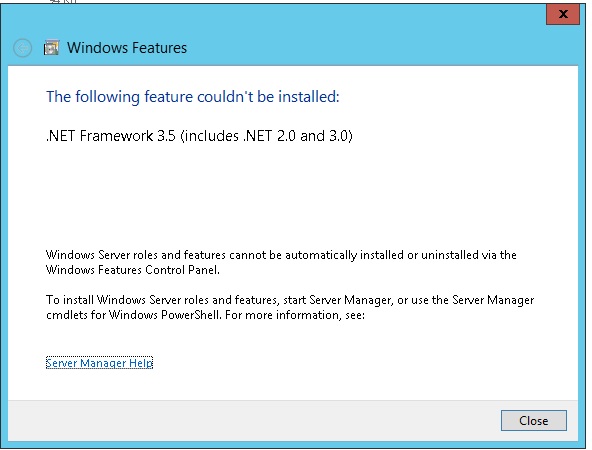
when I try to install .NET 3.5  from Server Manager on Windows Server 2012, I get the following screenshot:
enter image description here
Does that mean I can't install it ?
Answer is sure NO !
you can simply install it offline in 2 steps:
1- open the CMD (run as administrator)
2- type  the following command
Dism.exe /online /enable-feature /featurename:NetFX3 /All /Source:d:\sources\sxs /LimitAccess
where D: represent windows 2012 source drive.

4/13/2016

3 Tips To Prevent A DDoS Attack

Distributed denial-of-service (DDoS) attacks are always in top headlines worldwide, as they are plaguing websites in banks, and virtually of almost every organization having a prominent online presence. The main cause behind the proliferation of DDoS attacks is that there is a very low-cost that the attacker has to incur to put such attack in motion. Fortunately, today various prevention methods have been developed to tackle such attacks.
There are several ways to prevent the DDOS attack; the following are three basic tips that will help you to protect your website from the DDoS attack.
  1. Get More Bandwidth:
One of the easiest methods is to ensure that you have sufficient bandwidth on your web. You’ll be able to tackle lots of low-scale DDOS attacks simply by buying more bandwidth so as to service the requests. How does it help? Well, distributed denial of service is a nothing more than a game of capacity. Let’s suppose you have 10,000 computer systems each distributing 1 Mbps directed towards your way. This means you’re getting 10 GB of data that is hitting your web server every second. Now, that’s causes a lot of traffic!
So to avoid such issue, you need to apply the same rule intended for normal redundancy. According to this technique, if you wish to have more web servers just multiply around diverse datacenters and next make use of load balancing. By spreading your traffic to various servers will help you balance the load and will most likely create large space adequate to handle the incessant increase in traffic.
However, there’s a problem with this method that is buying more bandwidth can be a costly affair. And as you’ll know that the current DDoS attacks are getting large, and can be a lot bigger exceeding your budget limit.
  1. Opt for DDoS Mitigation Services:
A lot of network or Internet-service providers render DDoS mitigation capabilities. Look for an internet service provider having the largest DDoS protection and mitigation network, automated tools, and a pool of talented anti-DDoS technicians with the wherewithal to take action in real-time as per the varying DDoS attack characteristics. A viable alternative is to utilize a DDoS prevention appliance, which is specifically intended to discover and prevent distributed denial-of-service attacks.
  1. Restricted Connectivity:
In case you have computer systems that are connected to the web directly, a better idea is to properly install/configure your routers and firewall so as to limit the connectivity. For an instance, while receiving some data from a client machine you can only allow traffic to pass from the machine only on a few chosen ports (like HTTP, POP, SMTP etc.) via the firewall.
4/05/2016

Next-Generation Firewall (NGFW)

A next-generation firewall (NGFW) is a hardware- or software-based network security system that is able to detect and block sophisticated attacks by enforcing security policies at the application level, as well as at the port and protocol level.
Next-generation firewalls integrate three key assets: enterprise firewall capabilities, an intrusion prevention system (IPS) and application control. Like the introduction of stateful inspection in first-generation firewalls, NGFWs bring additional context to the firewall’s decision-making process by providing it with the ability to understand the details of the Web application traffic passing through it and taking action to block traffic that might exploit vulnerabilities.
Next-generation firewalls combine the capabilities of traditional firewalls – including packet filtering, network address translation (NAT), URL blocking and virtual private networks (VPNs) -- with Quality of Service (QoS) functionality and features not traditionally found in firewall products. These include intrusion prevention, SSL and SSH inspection, deep-packet inspection and reputation-based malware detection as well as application awareness. The application-specific capabilities are meant to thwart the growing number of application attacks taking place on layers 4-7 of the OSI network stack.

4/02/2016

How TO Add Static route to your windows Device ?

do you know that you can add additional routes to your default route (default Gateway ), all
what you have to do is to write the below command !

static route

3/31/2016

Facts About Computer Hacking

A computer hacker is somebody skilled at manipulating computers. Generally, the term hacker is used to refer to a person who breaks into computer systems. Hackers may do this for material gain, to harm another person or as a prank. A hacker may also have more positive motivations -- some hackers aim to expose security flaws before other, less scrupulous people can exploit them. Some businesses hire hackers for this purpose. A hacker may break into an individual computer or a network of computers.

Hackers vs. Crackers

  • The term "cracker" refers to someone who breaks into computer systems maliciously. A hacker on the other hand may possibly have benign motivations. Some people use the term hacker only to refer to non-malicious individuals, with criminals or vandals being branded as "crackers."

Kinds of Hacking

  • Purely benign hacking is sometimes called white hat hacking. Purely malicious hacking is called black hat hacking. Gray hat hacking means hacking in a non-malicious but not necessarily benign way. Blue hat hackers are hackers who have been hired to look for exploits (security vulnerabilities) in new software before it is launched. A "hacktivist" is someone who uses hacking to pursue ideological ends.

Script Kiddies

  • At one time, it was necessary to have a degree of programming skill to be a hacker. This changed with the advent of pre-packaged software toolkits that can be used to create malware and hack systems with little understanding of underlying workings. The term "script" came to be applied to these tools and users are nicknamed "script kiddies," implying juvenility and lack of experience. Script kiddies are also known as script kitties, script bunnies, script-running juveniles (SRJs) or skids.

Neophytes

  • A new hacker who is just starting out may be called a neophyte. Less polite terms include n00b (from newbie, meaning someone who is new). A neophyte differs from a script kiddie in that script kiddies are usually not interested in improving their skills, whereas a neophyte may be keen to learn more about computer technology and hacking. The opposite of a neophyte is an elite hacker -- someone with exceptional skills.

Exploits

  • A security exploit is a flaw in a system that allows hackers to break in. Operating systems, browsers and other software can all contain these flaws, as can some websites. Hackers can use these flaws to vandalize computer systems, steal data and take control of computers for their own use. They may also deface websites or make them unavailable.

Hacker Subculture

  • Hackers have their own subculture. They have their own slang and jargon which helps to demarcate in-groups and also conceal activities from law enforcement. There are books and magazines aimed at improving one's hacking skills. Hacker groups, conferences and conventions allow hackers to trade advice and techniques. Some hacktivists work in groups.

Early Hackers

  • The first hackers were not breaking into or misusing computer systems, but instead trying to make them do new things. In the late 1950s a group of students at MIT "hacked" an early computer using their own punched cards, the data storage method in use at the time. They were able to use the computer -- an IBM 704 mainframe -- to control a panel of lights.

Hacking in Popular Culture

  • Hacking first reached general public consciousness during the 1980s. This decade saw the rise of the cyberpunk genre of science fiction and the release of the first movie about hacking, 1983's "War Games." A TV show entitled "Whiz Kids" featured the adventures of a band of school-aged computer wizards who engaged in unlikely adventures as hackers.